
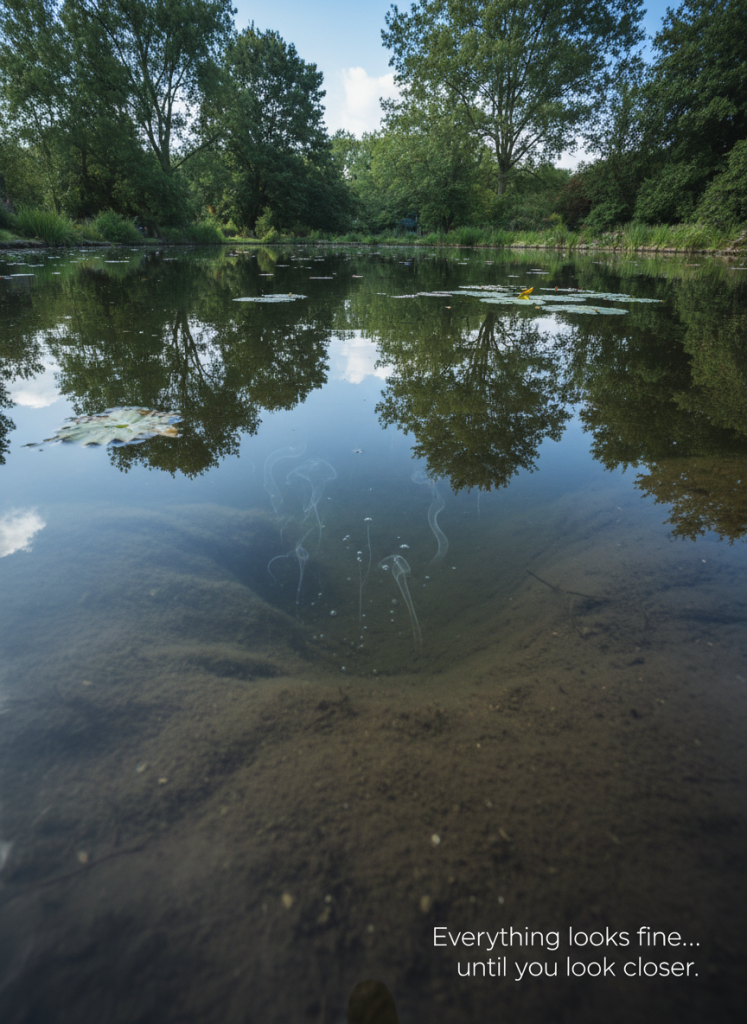
If you’ve ever disturbed the bottom of a pond and noticed a strong rotten-egg smell, it can be unsettling.
For some pond owners, it raises immediate concerns about water quality, fish health, or whether something has gone badly wrong below the surface.
That smell is usually caused by a gas called hydrogen sulphide — and while it should be taken seriously, it’s also widely misunderstood.
At AquaFanatics, we spend a lot of time helping clients understand what their pond is telling them. Hydrogen sulphide isn’t a random failure or a sign of neglect. It’s a natural chemical process that occurs when parts of a pond lose oxygen for long periods of time.
Understanding why it forms — and how to prevent it — is key to keeping your pond healthy, stable, and enjoyable year-round.
What is hydrogen sulphide?
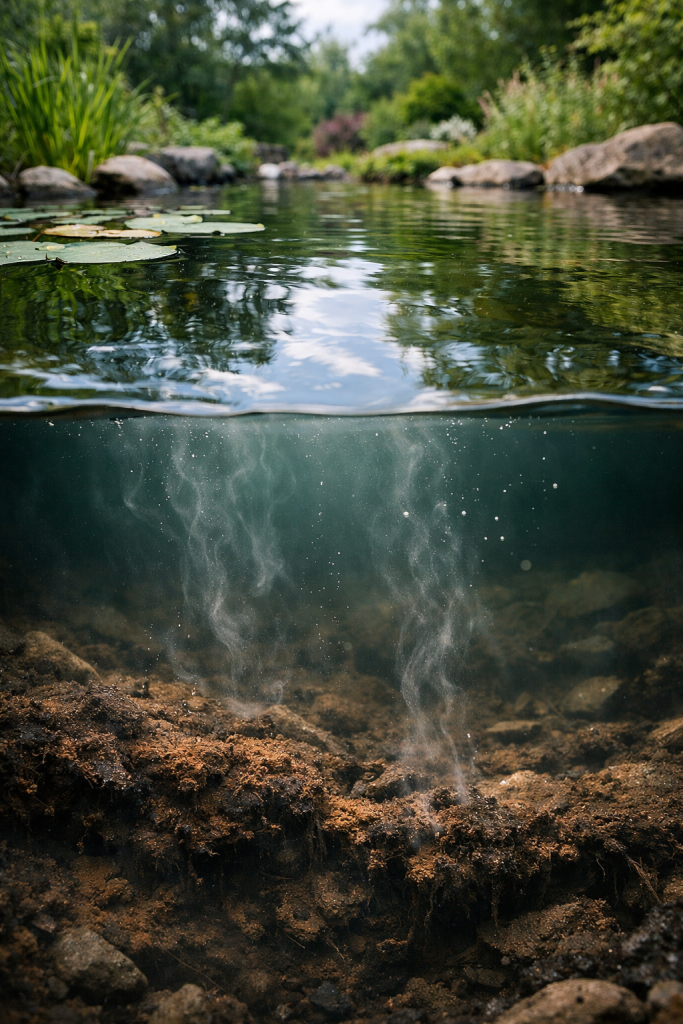
Hydrogen sulphide is a colourless gas with a very distinctive smell, often compared to rotten eggs or sulphur. In ponds, it forms below the surface, usually trapped within sludge, silt, or compacted organic material at the bottom.
You don’t normally notice it until that material is disturbed — during cleaning, planting, fish activity, or even heavy rainfall that shifts sediments.
While the smell is unpleasant, it’s actually useful. It acts as a warning signal that oxygen has not been reaching parts of the pond for some time.
Why oxygen matters more than most people realise
All ponds rely on oxygen — not just for fish, but for the invisible biological processes that keep water clean and balanced.
In a healthy, well-designed pond:
- Oxygen is present throughout the water column
- Beneficial bacteria break down waste safely
- Organic debris decomposes steadily, not aggressively
However, oxygen doesn’t travel easily through sludge or compacted silt. Once organic material builds up and compresses, oxygen can no longer penetrate the lower layers.
That’s where the chemistry begins to change.
The hidden world at the bottom of a pond
Pond water behaves in layers. Near the surface, oxygen from the air and plants is plentiful. As you move downward — especially into soft sediments — oxygen levels drop rapidly.
When oxygen is present, aerobic bacteria dominate. These bacteria:
- Use oxygen to break down waste
- Produce harmless by-products
- Support clear, stable water
But when oxygen runs out, those bacteria can no longer function.
Nature doesn’t leave a vacuum. Instead, a different group of bacteria takes over.
The bacteria behind hydrogen sulphide
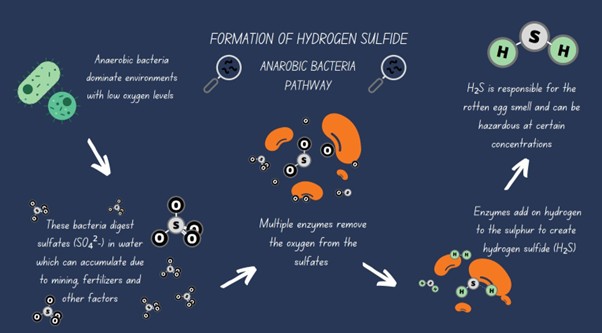
In low-oxygen (anaerobic) conditions, sulfate-reducing bacteria become active. These bacteria are not invaders or contaminants — they are naturally present in soils, sediments, and water bodies everywhere.
They exist quietly in the background until oxygen disappears.
When that happens, they switch to a different method of breaking down organic matter. Instead of using oxygen, they use sulfate, a naturally occurring compound found in most freshwater systems.
The by-product of this process is hydrogen sulphide gas.
This is a well-documented, well-understood process in lakes, wetlands, rivers, and ponds — not a pond-keeping anomaly.
Why hydrogen sulphide builds up silently
Hydrogen sulphide usually forms slowly and invisibly. Because it’s produced inside sludge layers, it often remains trapped for months or even years.
You’re most likely to encounter it when:
- Sludge is stirred during maintenance
- Plants are pulled from the pond base
- Fish disturb deep sediments
- Heavy rain or water movement shifts compacted silt
When released suddenly, the smell can be strong — and in extreme cases, it can pose a real risk to fish.
Is hydrogen sulphide dangerous?
In high concentrations, yes — hydrogen sulphide is toxic to fish and aquatic life, even at very low levels.
That said, the presence of the smell does not automatically mean your pond is unsafe. In most cases, it indicates:
- Localised oxygen depletion
- Excess organic build-up
- Poor circulation at the pond base
The real danger comes when large volumes of trapped gas are released quickly, such as during aggressive cleaning or sudden dredging.
This is why professional pond management focuses on prevention and control, not just removal.
Common pond conditions that encourage hydrogen sulphide
Over time, we see hydrogen sulphide most often in ponds with one or more of the following characteristics:
- Thick layers of leaf litter or plant debris
- Fine silt accumulation with little disturbance
- Poor bottom-level circulation
- Overstocking of fish
- Under-sized or poorly matched filtration
- Long periods of stagnation (especially in summer)
It can occur in:
- Wildlife ponds
- Koi ponds
- Natural swimming ponds
- Formal ornamental ponds
No pond type is immune — design and maintenance are what matter most.
Why “quick fixes” don’t work
It’s tempting to reach for treatments, additives, or aggressive clean-outs when a problem becomes noticeable. Unfortunately, these approaches often make things worse, not better.
- Chemicals and “sludge busting” additives may mask symptoms but realistically, will not restore oxygen levels
- Hasty or poorly planned out deep sludge removal can release trapped gas suddenly into the water column where it can harm the fish.
- Over-cleaning with harsh chemicals can remove beneficial bacteria
- Shock interventions destabilise the pond ecosystem
Hydrogen sulphide isn’t the root problem — it’s a symptom.
The long-term solution: restoring oxygen balance
The most effective way to prevent hydrogen sulphide is simple in principle, but requires a considered approach:
- Ensure oxygen reaches the pond base
- Manage and prevent organic material buildup before it compacts
- Encourage steady biological breakdown
- Design out dead zones where water doesn’t move
When oxygen is restored, sulfate-reducing bacteria naturally become inactive again. The system rebalances on its own.
This is why we always assess:
- Pond depth and shape
- Circulation patterns
- Sludge composition
- Seasonal behaviour
- Fish load and feeding habits
Every pond is different, and solutions should be matched accordingly.
A note on natural ponds and wildlife ponds
It’s worth noting that some level of anaerobic activity is normal in natural systems. Wetlands and natural lakes often contain anaerobic zones without issue because they are balanced by scale and biodiversity.
Problems arise in garden ponds when:
- Systems are small
- Organic input is high
- Oxygen delivery is limited
The goal is not sterility — it’s balance.
What hydrogen sulphide is really telling you
Rather than seeing it as a failure, hydrogen sulphide should be viewed as information.
It tells us:
- Oxygen hasn’t been reaching part of the pond
- Organic material has been accumulating unchecked
- Circulation or design may need adjustment
When interpreted correctly, it allows us to intervene intelligently, not reactively.
The AquaFanatics approach
At AquaFanatics, we don’t treat symptoms in isolation. We look at ponds as living systems — shaped by physics, chemistry, biology, and design.
Our focus is always on:
- Long-term stability
- Reduced maintenance stress
- Healthy fish and plants
- Ponds that improve with age, not decline
Hydrogen sulphide is one of many signals a pond can give us. When you know how to read it, it becomes a tool — not a threat.
Final Thoughts
Hydrogen sulphide doesn’t mean your pond is failing.
It means oxygen hasn’t been reaching everywhere it needs to.
Restore that balance, and the chemistry resolves itself naturally.
If you’re ever unsure what your pond is telling you, the most important step is to understand why something is happening — not just how to make it disappear.
That understanding is what keeps ponds healthy for the long term.